
Ready to invest in AI?
Schedule time with Zeni's finance pros to learn more.
Thank you! Your submission has been received!
Oops! Something went wrong while submitting the form.
The short answer: Zeni is an AI finance platform for growth companies that need investor-ready reporting, runway forecasting, R&D tax credit support and books they own in QuickBooks Online, with a dedicated finance team on every plan. Finaloop is an ecommerce accounting platform for product brands that live or die by inventory, SKU-level margins and multichannel payouts from Shopify or Amazon. Both use AI, but they solve different problems.
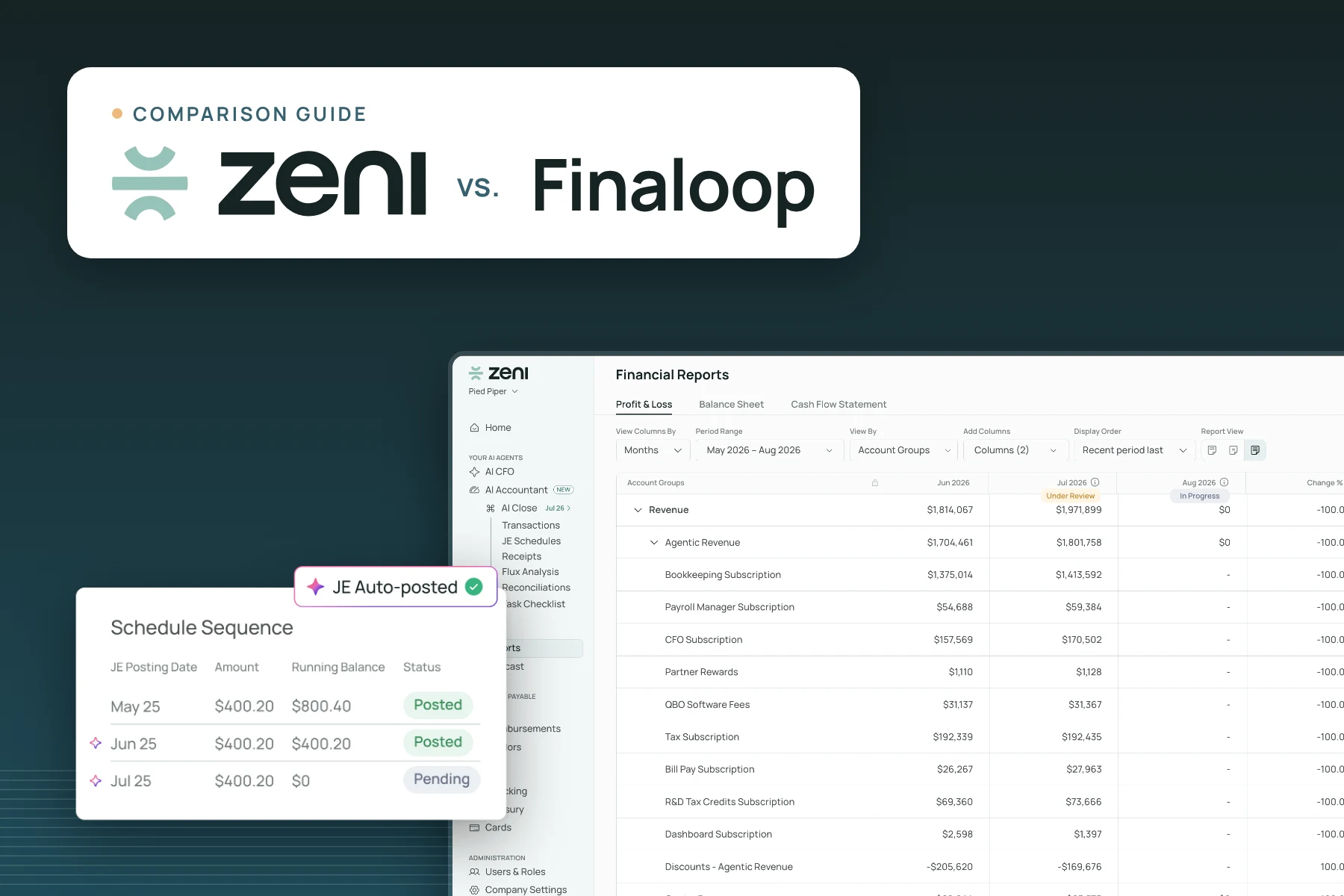
The Zeni vs. Finaloop comparison usually comes up when a founder or finance lead is leaving slow, human-only bookkeeping for an AI-driven finance stack. On the surface the two look alike: automated books, a real-time dashboard, a human team behind the AI. Underneath, the philosophies and target customers are very different.
I talk with founders, controllers and CFOs every week who are weighing this exact choice. Some of them pick Finaloop, and I'll tell you why. This guide covers the core difference, side-by-side features and pricing, who owns your books, how hands-on each accounting team is, and a 5-step test to make the call.
Last updated November 4, 2026. We checked every price and feature on this page against each company's public website on that date.
Want to see it on your own numbers? Schedule a Zeni demo.
Finaloop is an ecommerce accounting platform for consumer brands. It pairs its own accounting ledger with an accounting team, tracks inventory and COGS (including FIFO), and reconciles sales from channels such as Shopify and Amazon. Finaloop says it serves 2,500+ consumer brands.
Zeni is an AI accounting and finance platform for startups and growing companies, founded in 2019 and based in Palo Alto. Its AI Accountant and AI CFO work on your QuickBooks Online books, and every bookkeeping plan includes a dedicated finance team, Bill Pay and employee reimbursements.
Finaloop is an ecommerce accounting platform. It replaces both your bookkeeper and your accounting software with its own ledger, built for multichannel retail. Zeni is an AI finance platform for growth companies. It keeps your books in QuickBooks Online, with a dedicated finance team and an AI CFO layered on top.
That difference shapes everything else:
In plain terms, Finaloop answers "Which products actually make money?" Zeni answers "How much runway do we have, and what do I show the board?"
Finaloop leads on ecommerce depth, entry price and contract flexibility. Zeni leads on ledger ownership, CFO and tax depth, and a finance team on every plan.
| Zeni | Finaloop | |
|---|---|---|
| Built for | Startups and growth companies (1,500+ businesses served) | Ecommerce and consumer brands (2,500+ brands, per Finaloop) |
| Ledger | QuickBooks Online, owned by you | Finaloop's own proprietary ledger |
| Entry price | $549/mo Starter; $799/mo Growth | $245/mo Starter (up to $1M revenue, 4 years old or less) |
| Inventory and COGS | Inventory and COGS entries in QuickBooks; scope set on your demo call | Native, SKU-level, FIFO; InventoryIQ add-on for POs and landed cost |
| Multichannel payout reconciliation | Not a core specialty | Core feature, automated |
| Books updated | Daily, accrual-basis from day one | Continuously; advertises 48-hour onboarding |
| Human team | Controller, Bookkeeping Manager and Bookkeeping Analyst on every plan | Dedicated team on the Full-Service plan |
| Bill pay and reimbursements | Free on every plan, $0 ACH fees | AP/AR included on Full-Service |
| Fractional CFO | From $1,599/mo; Enterprise tier joins board meetings | Add-on, price not published |
| Business taxes and R&D credit | From $2,499/yr; R&D credit for 20% of credits received | Tax add-on, price not published |
| Go-live | Dashboard typically live within a week | Days |
| Contract | Billed monthly or annually (annual saves 10%) | Cancel anytime; 14-day free trial |
Finaloop details are from Finaloop's pricing page, homepage and help center, and Zeni details from Zeni's pricing page, as of November 4, 2026.
Finaloop starts at $245 a month for brands under $1M in revenue that are 4 years old or younger. Every other Finaloop plan is a custom quote. Zeni starts at $549 a month (pre-revenue) or $799 a month (revenue-generating), with published prices for CFO and tax services.
Finaloop prices from the ledger up. You start with the platform and books, then add services. Inventory management (InventoryIQ), analytics, fractional CFO, tax, demand planning and a data warehouse are all priced separately, and none of those prices are published. Historical catch-up is free for your onboarding month and the two months before it. Earlier months are billed at your monthly rate for each month caught up.
Zeni prices by tier, with a finance team in every plan. Bill Pay, employee reimbursements and the AI dashboard are included at no extra cost. Pricing scales with bookkeeping complexity, monthly expenses and annual revenue. Annual billing saves 10%.
| What you need | Zeni | Finaloop |
|---|---|---|
| Early-stage books | $549/mo Starter ($494/mo annually) | $245/mo Starter |
| Revenue-generating, full service | $799/mo Growth ($719/mo annually) | Custom quote (Full-Service) |
| Historical catch-up | Scoped on your demo call | 3 months free; earlier months at your monthly rate |
| Inventory operations | Scoped on your demo call | InventoryIQ add-on, custom |
| Business tax return | $2,499–$3,899/yr; custom above $500K revenue | Add-on, custom |
| Fractional CFO | $1,599, $2,990 or $4,990+/mo plus setup | Add-on, custom |
Here's the honest part. For pure ecommerce brands, price often decides it. Ecommerce and inventory work can raise Zeni's quote, and Finaloop's Starter tier is less than half of Zeni's entry price. If you're a young brand under $1M with simple needs, Finaloop will usually cost less.
The math changes when you need CFO support, a tax return, R&D credits or multi-year cleanup. Then you're comparing Zeni's published prices with a stack of unpublished Finaloop add-ons. Ask for every add-on in writing before you compare.
Prices are each company's published list prices as of November 4, 2026. Final pricing for both depends on complexity, volume and revenue.
A Finaloop alternative
Need CFO, tax or cleanup on top of your books? Compare full quotes.
Zeni publishes its CFO and tax pricing, and Bill Pay and reimbursements are included on every plan.
No. Finaloop doesn't use QuickBooks. Its help center says Finaloop replaces both your bookkeeper and your accounting software, and your books live on its proprietary platform. Zeni builds your books inside QuickBooks Online, in an account you own.
For most founders, this is the most important difference in the whole comparison, and the easiest one to overlook on a demo call.
Leaving Zeni: You keep your QuickBooks account. Revoke Zeni's access and hand the same ledger, with every transaction, to an in-house bookkeeper, a new firm, an auditor or an acquirer's diligence team.
Leaving Finaloop: Finaloop's help center says that if you leave, it can do a one-time sync of your data into a new QuickBooks account, and you can export reports to Google Sheets anytime. To Finaloop's credit, it says customers should never feel locked in. The difference is timing: with Zeni your books are in your own QuickBooks file every day, while with Finaloop the move to QuickBooks happens at the exit. Ask Finaloop what that sync includes before you sign.
Ownership also matters when the books are messy. One of our strongest wins against Finaloop came from a buyer who liked Finaloop's fast setup and integrations but needed 2022–2024 cleaned up, not just recent books. Because Zeni works in QuickBooks, our team could review the existing file, judge how much of the data could be trusted, and offer a repair-or-restart path with a dedicated accounting team.
If you expect to raise institutional capital, sell the company or ever bring finance in-house, ask yourself one question: where will my books live in three years?
Both companies put humans behind the AI. The difference is how involved they are. Finaloop is software-first and can be more hands-off on the accounting side, especially on its Platform plan, which is built for brands that already have a finance team. Zeni assigns every customer a dedicated finance team that checks the AI's work and digs into the numbers with you.
The theme shows up in our competitive deals. Buyers who came to Zeni from Finaloop often wanted more involved bookkeeping, financial statements updated throughout the month, and closer oversight of complex inventory such as bundles, components, freight, duties and tariffs.
Here's what involvement looks like at Zeni:
On average, Zeni customers save about 70 hours a month, depending on the size and complexity of their books. TeamBridge used to build investor metrics by hand in spreadsheets and now saves 53 hours a month. As CEO and co-founder Arjun Vora put it: "Because of Zeni I don't have to think about the financial space much."
Finaloop's Full-Service plan also includes a dedicated team, a monthly finance review and an account manager. When you compare, ask each vendor three things: who reviews the AI's work, how often you'll hear from them, and how fast a question gets a real answer.
Ask your numbers anything
See your runway, burn and margins from books updated today
Zeni's AI CFO answers questions from your live numbers, and your dedicated finance team reviews the books every day.
Finaloop is the better choice when most of your revenue comes from physical products sold across several channels, and SKU-level margins drive your decisions. That's the business Finaloop was built for, and it does that job well.
Brands that pick Finaloop usually do it for the same reasons: it's built for inventory and ecommerce, it's fast to set up, and it connects to a long list of ecommerce tools. For a young, simple brand, the price is hard to beat.
Finaloop is likely the right fit if:
Zeni can do ecommerce bookkeeping, and some product companies are better served by it. But if your business lives or dies by Shopify payouts and SKU margins, start with Finaloop.
Reality: "AI-powered" tells you nothing about what the AI was trained to do. Finaloop's AI reconciles commerce data: order IDs, marketplace payouts, processor fees and net bank deposits. Zeni's AI handles corporate finance: categorizing spend, reading invoices and receipts, and flagging changes in burn. Swapping one for the other is like running your CRM on a logistics database. Ask each vendor what its AI does, not whether it has AI.
Reality: Finaloop is efficient when your business fits its model. QuickBooks has a broad ecosystem of B2B and wholesale tools, so books built there have room to stretch as a brand changes. Add CFO, tax and cleanup add-ons, and the cheaper option may not stay cheaper.
Reality: You can, and Finaloop offers a one-time sync into a new QuickBooks account when you leave. But any accounting move takes planning: new investors, a fractional CFO or an auditor will want to review the history, and a mid-growth switch usually means another onboarding and a check of the migrated books. If you think you'll need a standard QuickBooks ledger within 18 months, it's simpler to start on one.
Switching from Finaloop
Move once, to books you own
One 30-minute onboarding call. Your books live in your own QuickBooks Online account, and the team catches up any books that are behind.
To choose, test five things in order: your revenue mix, who you report to, where you want your ledger to live, how clean your historical books are, and whether you need CFO and tax support. The first test settles it for most companies, and the rest settle the hybrids.
The rule of thumb: If your biggest headache is matching Shopify payouts to processor fees and tracking SKU margins, Finaloop is built for that. If it's preparing for a board meeting, managing venture runway and claiming R&D tax credits, Zeni is built for you.
Not sure where you land? Book a 30-minute demo and we'll walk through these steps with your own numbers.
Finaloop and Zeni are both strong, and they're built for different companies. Finaloop is the specialist for product-led ecommerce brands that need inventory accounting and multichannel reconciliation at a low entry price. Zeni is built for growth companies that need investor-ready books, a dedicated finance team, CFO and tax support, and a QuickBooks ledger they own outright.
If you're a hybrid, or you expect to raise, get audited or bring finance in-house, ledger ownership should weigh heavily in your decision. Switching later costs more than choosing right now.
Zeni vs. Finaloop
See your own books in Zeni
In 30 minutes, a Zeni finance expert walks you through the dashboard, your live metrics and a quote for your stage.
Sources we checked (November 4, 2026)
About the author
Ben Ashworth is the VP of Marketing at Zeni and has spent more than 15 years in growth marketing, including over a decade in fintech. He works with founders, controllers and CFOs every week as they evaluate how to modernize their accounting, from seed-stage teams to Series D finance organizations.