.avif)
![VC due diligence checklist [downloadable Excel + Sheets]](https://cdn.prod.website-files.com/642b3b2440806566d7573934/6a4ebffb55e7de746ffc7ea8_vc-due-diligence-checklist-feature-image.avif)

Ready to invest in AI?
Schedule time with Zeni's finance pros to learn more.
Thank you! Your submission has been received!
Oops! Something went wrong while submitting the form.
A venture capital (VC) due diligence checklist is a comprehensive list of documents, records, and information that a VC firm requests from a prospective investment company before deciding whether to deal with them.
These checklists help VC investors evaluate companies before committing capital. For example, this often involves assessing growth potential, evaluating key legal risks, and verifying financial stability.
Generally, a checklist facilitates these processes in three ways:
In practice, the contents of a due diligence checklist can vary significantly between venture capitalist firms. In addition, VC firms may adjust checklists further depending on the growth stage of the target company.
For example, you can expect VC investors to use significantly more intensive due diligence checklists for a Series B company than a Seed-stage startup, as more analysis is necessary to make an informed investment decision.
The due diligence process typically starts once initial screening convinces a VC firm to seriously consider investing. Before finalizing a deal, they'll conduct due diligence to verify key details and identify potential risks.
Rather than exchanging dozens of emails and attachments, many VC firms use a virtual data room to organize the process. These platforms provide a secure place for founders, investors, and other stakeholders to share and review information.
However, VC investor due diligence may look less quantitative than you expect. Because venture capital firms typically invest in startups and emerging companies, there can be relatively little historical data for the deal team to analyze.
This stands in contrast to private equity (PE) business due diligence. PE firms tend to target businesses with established operations, longer financial histories, and predictable cash flows, making quantitative analysis a larger part of the process.
As a result, an early stage startup may face less emphasis on financial metrics. Rather than focusing on non-existent revenue, investors may spend more time evaluating the founding team, product-market fit, and long-term growth potential.
That said, quantitative data becomes increasingly important as your company matures. For example, a VC investor may not expect meaningful revenue from a seed-stage startup, but they will likely expect measurable traction by Series A and beyond.
What a VC fund includes in its due diligence checklist depends on factors like your company's growth stage and the firm's unique investment preferences. However, you can generally expect checklists to cover areas like the following:
While the specific documents involved may vary, the purpose of a VC due diligence checklist is always the same: to help firms determine if your company is an attractive opportunity so they can make an informed decision about investing.
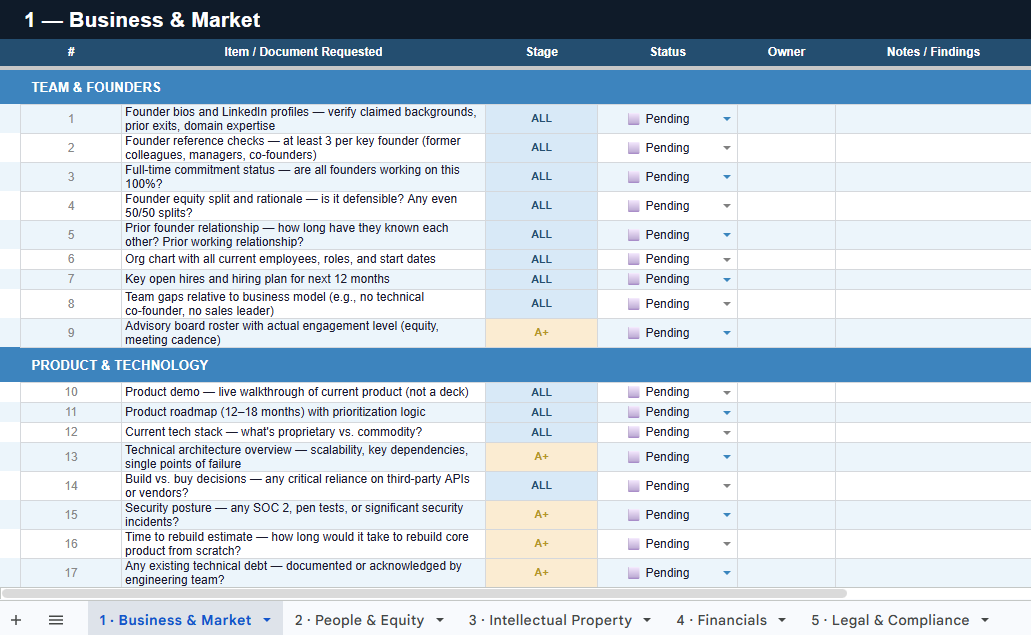
To help you understand how VC due diligence checklists work in practice, let's use our downloadable template as an example. We organized it around five key areas that investors commonly evaluate:
In addition, the tabs contain a column that clarifies which types of companies our hypothetical VC firm expects to provide each item. This should help you understand how requirements change at various stages of development.
You can use this template as a starting point when preparing for fundraising. However, VC firms will typically provide their own checklists once thorough due diligence begins, and you should defer to theirs at that point.
Mistakes while fulfilling a VC firm's due diligence checklist can damage investor confidence and disrupt the fundraising process, potentially jeopardizing an important investment. Here are some pitfalls to avoid:
Fortunately, avoiding these mistakes is often relatively straightforward for startups, if not easy. When companies are young, due diligence issues often stem from a lack of discipline rather than overwhelmingly complex situations.
VC firms evaluate many aspects of a business during due diligence, but financial and legal considerations often represent the two most tangible risk areas, especially as your company grows in size and complexity.
While early-stage VC investors may focus more heavily on things like the target market size or the founder’s track record, later-stage investors often expect to see robust financial reporting controls and regulatory governance.
Financial due diligence involves an assessment of your company's current financial stability and long-term viability. Investors want confidence that your business can survive in the short term and ultimately generate a strong return.
To evaluate this aspect of your company, they typically review records like your financial statements, budgets, and financial projections. Together, these provide insight into both historical performance and future expectations.
Meanwhile, legal due diligence is about ensuring the safety of a VC firm’s investment. They want to know that your company is operating in such a way that minimizes the chance of performance disruptions due to legal or regulatory penalties.
Some of the most emphasized documents during this aspect of venture capital due diligence include cap tables, intellectual property ownership agreements, and contracts with notable vendors and customers.
For more information on the startup due diligence, you can read our articles on How to Prepare a Due Diligence Report and Series B Due Diligence.
From customer acquisition and product development to daily bookkeeping and cash flow forecasting, growing startups have a lot to manage.
It’s all too easy for finances to take a backseat, but that can have serious consequences—especially once you start to pursue VC funding aggressively.
Zeni's AI CFO uses agentic AI and machine learning to take complex financial workflows off your plate.
For example, it can automate tasks as sophisticated as scenario planning and runway projection, significantly streamlining your strategic financial planning.
Schedule a free consultation to see how Zeni's AI CFO can help your startup improve financial visibility and drive long-term growth.