The best banks for startups offer significant benefits over most traditional institutions, including superior interest rates on deposits, much higher FDIC insurance coverage limits, and little to no recurring fees or minimum opening deposit requirements.
Here are our top five recommendations for accounts that meet these criteria and everything you need to know about their pros and cons to determine which of them is the right bank for you.
The best banks for startups in 2026
The best banks for startups compared
1. Zeni: Best overall

Zeni is an AI bookkeeping software backed by a dedicated finance team. One of their products includes Business Checking Accounts.
Pros of Zeni business banking
- AI-Powered: Zeni's checking accounts use AI to automatically categorize transactions, identify vendors, assign classes, and reconcile transactions for a faster month-end close.
- Holistic approach: Zeni’s Business Checking Account is connected to all other finances including cards, revenue, and expenses, unlike traditional banks which only display platform-specific spending.
- Up to 2.90% APY: Earn up to 4.05% on your deposits — far above the near 0% rates offered by traditional bank accounts.
- $3M FDIC Insurance: Rest easy, with more than 10x protection than what’s offered by traditional banks, thanks to automatic Insured cash sweep services.
- Expert support: Provides personalized, expert support tailored to the specific financial needs of your business.
- Real-time cash liquidity: Unlike a money market account, you’re able to send and receive payments seamlessly, with no waiting period.
- Free wire transfers: Save $15-$20 per transaction, paying $0 for both USD Domestic & International transactions.
- Personalized sub-accounts: Organize your finances with unlimited sub-accounts, each with its own account number for better budgeting and management.
Cons of Zeni business banking
- No interest on investment accounts: Zeni only offers 2.90% APY on checking deposits.
- No cash deposits. If your startup relies on cash deposits, Zeni will not be able to meet your needs as there are no physical locations or ATMs.
2. Mercury

Mercury is a tech-focused bank built for startups. While it specializes in working with tech companies, any type of business can bank with Mercury.
One of the biggest benefits of Mercury is its incredibly straightforward offering and easy-to-use platform. For example, startups can sign up and gain access to a business checking and savings account and a debit card in as little as 15 minutes.
Pros of Mercury business banking
- Internet-based. Mercury offers all of its services online — everything you need without visiting a physical bank branch.
- Security and privacy. Mercury offers up to $5M in FDIC insurance by spreading your cash deposits across up to 20 different banks.
- Send and receive funds for free. Electronically send money between accounts for free. ACH transfers and wires are always free in U.S. dollars, domestically and internationally.
- Host multiple users. Mercury understands that small business owners aren’t the only ones who need access to the business bank account. Mercury offers options for an unlimited number of admins, such as your bookkeepers or other financial staff.
- US and International Businesses. While Mercury focuses heavily on US-based startups, international businesses who work in the U.S. can also open a Mercury business bank account.
Cons of mercury business banking
- New bank. Mercury is still a relatively new bank, thus may not have big perks and additional features as the more established best banks for startups.
- No cash deposits. If your startup relies on cash deposits, Mercury will not be able to meet your needs as there are no physical locations or ATMs.
- Not the best customer support. Some customers reported issues with their customer support, specifically about its live chat.
See also: 8 Best Accounting Tools for Startups
3. Brex Cash

While Brex Cash technically isn’t a bank, we decided to include it here for their “cash management account” offering. A cash management account (CMA) provides all that a business bank account does with fewer fees. You can manage all transactions on one portal, make deposits, trade securities, and even write checks with a CMA.
In 2021, Brex Cash raised a whopping $425 million through its Series D round to help it create a more comprehensive financial solution for startups and businesses.
Pros of Brex Cash
- Easily access your funds. Brex Cash offers all the services of a traditional or personal bank account in addition to a user-friendly online platform. Since it is an online-only business, you can easily access your money online and from the Brex app.
- Strong APY. Compared to other startup financial management options, Brex offers one of the best APYs, helping your cash earn a yield of up to 3.68% in a treasury account.
- No fees. Brex Cash is an affordable banking option for startups because it does not charge any fees on transactions, ACH or wire transfers. There is also no minimum balance requirement, so you can store maximum funds at no cost.
Cons of Brex Cash
- Limited cash deposits. Brex Cash is ideal as an online solution or a business credit card. However, it isn’t a good solution if your startup relies on cash deposits. Brex Cash has no physical location, and finding a compatible ATM is difficult — you may acquire ATM fees as a result.
4. Bluevine

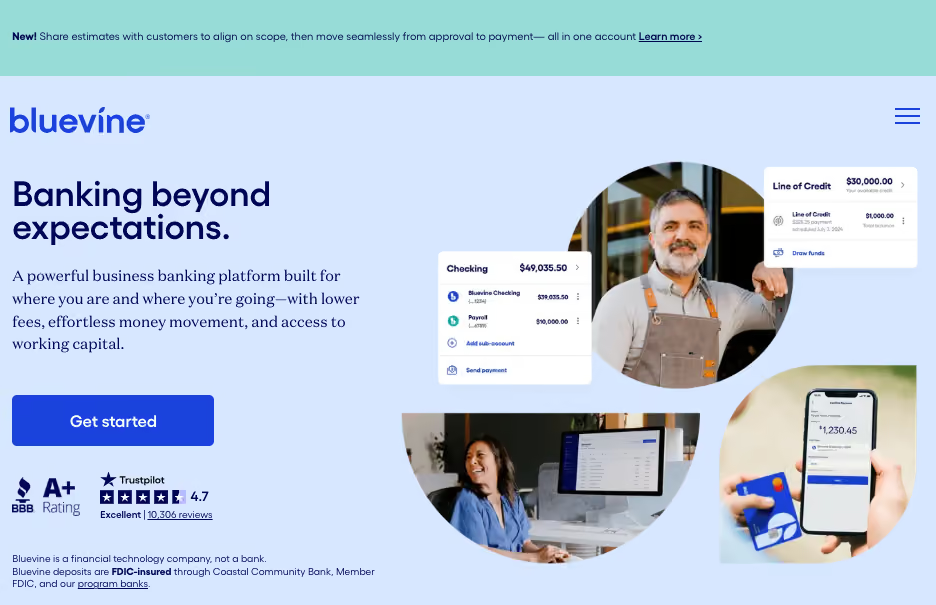
Bluevine is a digital banking platform designed specifically for self-employed individuals, small businesses, and startups.
It uses a tiered subscription model, with the Standard plan providing free access to its essential banking tools. These include high-yield interest earnings, integrated bill pay, and flexible payment acceptance.
You can also upgrade to a paid plan for $30 or $95 per month to get increasingly advanced features and cheaper transaction fees, such as lower incoming and outgoing international wire costs.
Regardless of your subscription tier, Bluevine Business Checking Account users gain streamlined access to the platform’s business line of credit.
Pros of Bluevine
- Avoidable monthly fees: Bluevine offers several subscription plans, including one that costs $0 per month while still providing access to the platform’s primary features.
- Streamlined financing: Checking account holders can easily apply through the dashboard for a business line of credit of up to $250,000. There’s no hard credit check, and you only need a FICO score of 625. If approved, account holders have instant access to withdrawn funds.
- High-yield interest: With the Standard plan, you can earn up to 1.3% APY on up to $250K in your checking account by meeting monthly activity requirements. With the Premier plan, that rate goes up to 3.0% and applies to all balances. Meanwhile, Bluevine Treasury offers up to 5.986% yield for Premier subscribers or those with $50K in their checking.
- Accounts payable: Initiate ACH and wire transfer payments directly from your dashboard, which also provided features like invoice capture, approval workflows, and QuickBooks Online integrations.
- Payment acceptance: Create unlimited free invoices and accept payments through a wide range of methods. Beyond ACH and wire transfers, that includes built-in payment links and tap-to-pay cards.
- ATM access: Unlike many digital-only bank accounts, Bluevine lets you deposit and withdraw physical cash through certain ATM networks, including Allpoint+, Greendot, and MoneyPass, though limitations apply.
Cons of Bluevine
- Payment fees: While standard domestic ACH wires are free, Bluevine charges $10 for same-day ACH and $15 per domestic wire. Meanwhile, international payments carry a $25 fee plus a 1.5% currency exchange fee.
- Cash deposit fees: While cash deposits are possible via partner networks, they aren't free. You’ll pay $1 plus 0.5% of the deposit amount at Allpoint+ locations or a flat $4.95 fee when using Green Dot.
5. Wells Fargo

Wells Fargo is one of the most well-known banking solutions for individuals and businesses and is a leading small business bank. Even as a well-established financial institution, they offer many perks for startups, including an excellent small business credit card and small business loans.
They also offer different business checking accounts; for startups, the Navigate Business Checking Account includes up to 250 transactions and $20,000 in cash deposits processed per fee period at no charge. This type of account supports new and growing businesses with a steady volume of banking activity.
Pros of Wells Fargo startup banking
- Nationwide banking solutions. Wells Fargo maintains the second largest branch network in the U.S, with more than 4,000 branches and 11,000 ATMs. Its widespread access makes it easy to deposit or withdraw funds from anywhere, especially for those small businesses that frequently deal with cash transactions.
- Checking account options. Wells Fargo has some of the most diverse checking account options based on the stage of your business and average account balance. These include Initiate Business Checking, Navigate Business Checking, and Optimize Business checking.
- Waiving monthly maintenance fees. While fees exist, Wells Fargo offers many opportunities to waive business checking monthly maintenance fees. For example, if you maintain a specific minimum daily balance, you don’t have to pay a monthly fee.
- Excellent business credit card perks. Wells Fargo makes it easy for small businesses to qualify for a credit card. Their startup credit cards also offer great perks, including travel rewards and cashback on all purchases.
Cons of Wells Fargo startup banking
- Low APY. Wells Fargo has some of the lowest APY rates, even as low as 0.01%. If you’re looking for high-yield savings, look at other options such as Brex Cash.
- App performance is low. Wells Fargo isn’t a tech-first company, so its mobile app doesn't work as best as modern banking and finance brands. If this is important for your business, choose a tech-focused or online-only business bank that optimizes its service for digital use.
- Not experts in startup banking. While many of Wells Fargo's small business banking products are relevant and appealing, it does not have an internal group dedicated to helping venture-backed startups (like most others on this list).
See also: Startup Bookkeeping: Common Mistakes VC-Backed Startups Make and How We're Solving Them
How we reviewed these products
Account type
Other options for startup banking accounts range from simple checking and savings accounts, to more complex money market accounts and cash management accounts.
Requirements to open a business bank account
Before moving forward with the application process, be sure you and your business meet the qualifications to open a business bank account.
Fees
New entries into the startup banking industry offer the most competitive low and no-fee banking products and services.
Details of each bank’s fees are available via their respective landing pages, where you can sift through the fine print:
- Zeni pricing breakdown
- Mercury pricing breakdown
- Brex Cash rates and fees
- First Republic Banking for Innovators schedule of fees
- Wells Fargo Navigate Business Checking fees
Accessibility
Startup founders are on the go 24/7 and require a banking partner who can rise to the occasion to meet their needs. This chart will help you judge how easy it will be to access your company’s bank account or contact customer support about an urgent matter.
See also: Accounting Software Comparison for Startups
Security & insurance
Account security is paramount when deciding where to store your startup’s cash.
See also: Startup Bookkeeping: Common Mistakes VC-Backed Startups Make and How We're Solving Them
Which startup bank will you choose?
Whether you're evaluating a banking partner for a new business or looking to change your current banking setup, use this guide to help you compare the top startup banking options, including business checking accounts, for your needs.
While finding the bank with the best business banking features is crucial, your financial management efforts will benefit tremendously from expert assistance. For the rest of your startup's finance-related needs, take a closer look at Zeni.
Zeni uses a combination of AI and human finance experts to maintain accurate books and manage all of your financial functions. Services include daily bookkeeping, ongoing accounting services, access to our finance concierge, bill pay and invoicing, budgeting and projections, annual taxes, CFO services, and streamlined management of your business checking account.
Zeni customers also gain access to a single dashboard to view and manage their finances in real-time, including their business checking account activity.
Manage your cash flow effortlessly with Zeni. Book a free demo to learn about our real-time bookkeeping and comprehensive financial management so you're always in the loop with your finances.
.avif)

.avif)


.avif)
.avif)