.avif)


Ready to invest in AI?
Schedule time with Zeni's finance pros to learn more.
Thank you! Your submission has been received!
Oops! Something went wrong while submitting the form.
In the 2026 Accountant AI Survey, Zeni polled 100 accounting professionals, including public accountants, in-house accountants, and finance leaders, on the state of their business and its relationship with artificial intelligence (AI).
This report analyzes our independent research, providing practical insight into key 2026 accounting trends. For example, we’ll explore the rate of daily AI use, the growing emphasis on advisory services, and the current state of the accountant shortage.
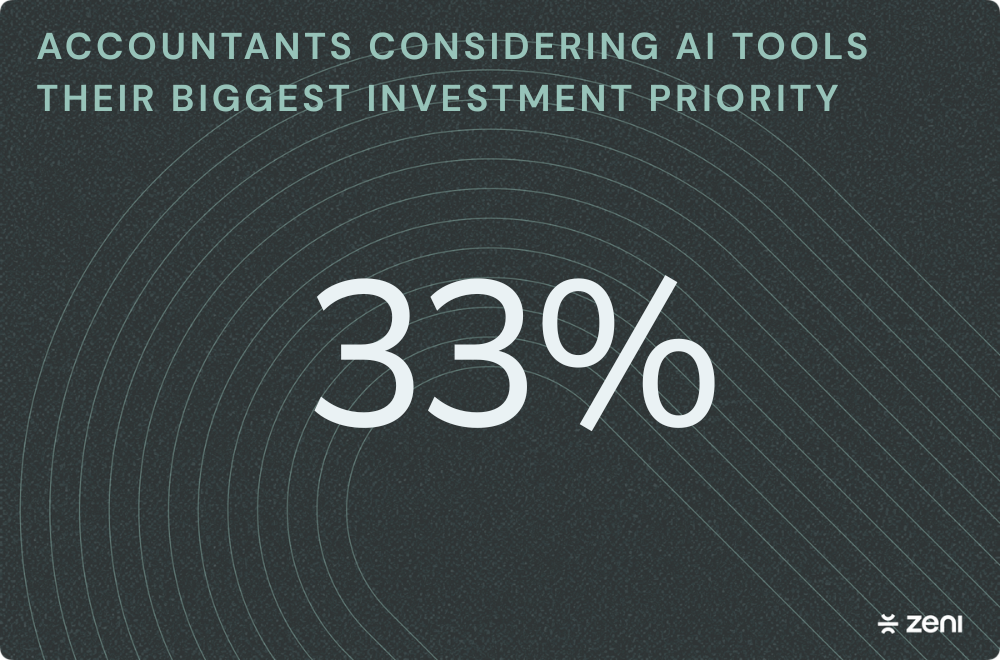
When we asked accounting professionals what their single biggest investment priority was for the coming year, a third of respondents (33%) selected AI tools, making it the most common answer by a meaningful margin.
However, hiring and talent acquisition came in a strong second at 24%. While recruitment is always important for long-term growth, its prevalence in this dataset may be a reflection of the ongoing accountant shortage.
Meanwhile, expanding advisory services was the third-highest priority at 19%. This is likely another symptom of the AI wave, as 32% of survey respondents noted that they are directing capacity freed by automation to advisory work.
Demand for accounting talent remains as strong as ever. According to the AICPA’s 2025 report on accounting industry trends, 75% of accounting firms that hired accounting graduates in 2024 planned to recruit the same number or more in 2025.
However, the number of new accounting graduates has fallen steadily for the better part of a decade, resulting in a persistent shortage. It went from 78,518 in the 2017–2018 academic year to just 55,152 in 2023–2024, a decline of nearly 30%.
Over the same period, the accounting industry has seen a similar decrease in Certified Public Accountant (CPA) exam candidates. While the number sat at 39,436 in 2017, it fell to just 28,082 by 2024.
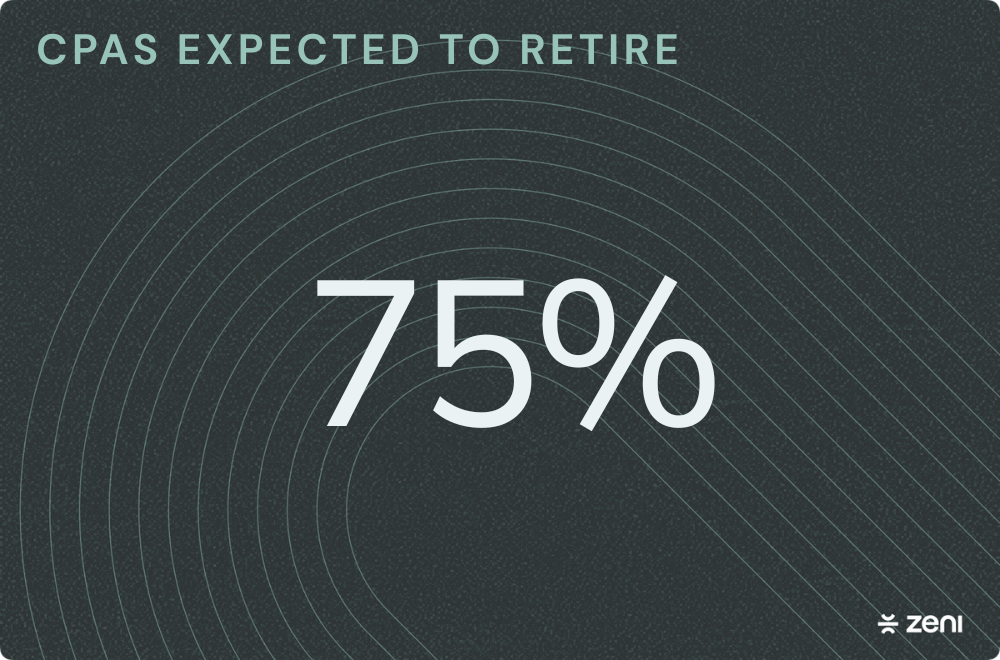
What’s more, the AICPA found that approximately 75% of CPAs are Baby Boomers who are expected to retire within the next decade. They call this the “Silver Tsunami”.
The results of our research reflect this gap between supply and demand. Of the accounting professionals we surveyed, 60% said that it has been somewhat or very difficult to hire qualified accounting staff in 2026.
However, the shortage isn’t being felt equally across the profession, as public accountants reported the greatest hiring challenges by far. In fact, 80% said that recruitment has been difficult compared to just 41% of finance leaders.
Notably, public accountants are also the most likely to expect that AI will cause their role to shift toward advisory services, with 52% predicting that outcome compared to just 34% to 38% of other accounting professionals.
This suggests that staffing pressures may be accelerating the shift of CPA firms away from compliance work and toward higher-value advisory services.
All that said, the downward trend in the supply of accounting graduates is finally showing signs of reversing. Enrollment in U.S. accounting programs hit 266,506 students in 2025, up 12.4% from 2024 and the highest it’s been since 2020.
Only a few years ago, many accounting professionals were just experimenting with adopting AI tools. However, in 2026, these solutions have become a regular part of the workday for many CPA firms and finance teams.
More than nine in 10 (91%) of the accountants we surveyed said that they use AI tools at least occasionally, if not regularly. Only 5% said they don't currently use AI and have no plans to incorporate the technology into their work.
Probing deeper into specific usage levels, we found that more than half of accounting professionals (54%) said they use AI for work daily. Another 37% use it weekly, meaning only 9% use it monthly or less.
This frequency of use appears to be driving tangible productivity gains. Forty-two percent of our survey respondents estimated that AI saves them between one and five hours per week, and another 25% reported weekly savings of six to 10 hours.
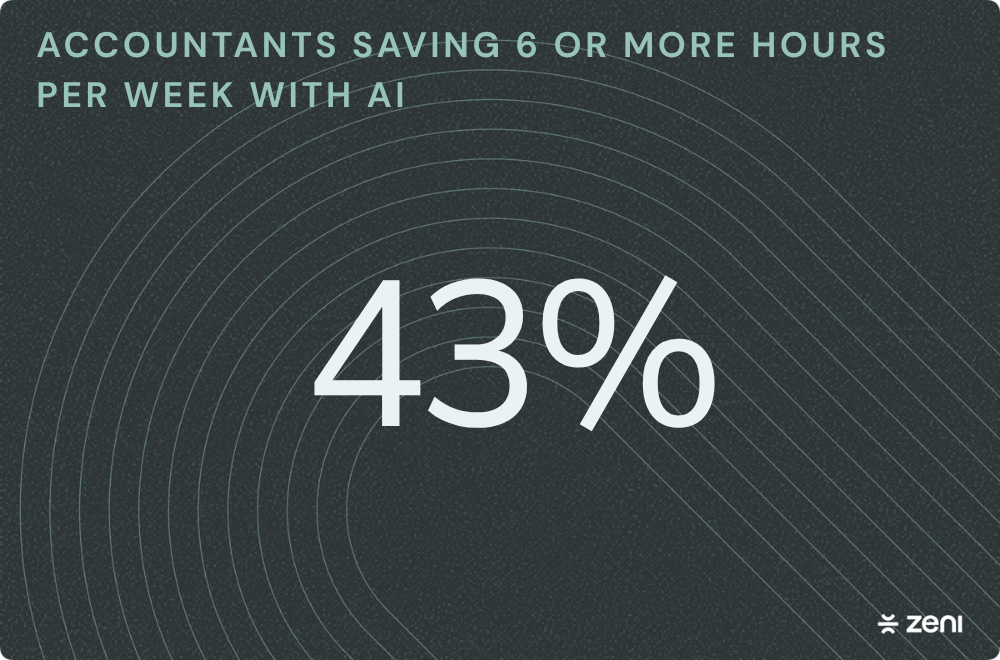
For some organizations, the impact is even greater. Nearly one in five respondents (18%) said AI saves them more than 11 hours per week. Meanwhile, only 15% reported saving less than one hour or no time at all.
While general-use chatbots like ChatGPT, Claude, and Gemini remain the most commonly used AI tools in accounting (76%), accountants are also increasingly adopting AI solutions specifically designed for finance and accounting workflows.
According to our survey:
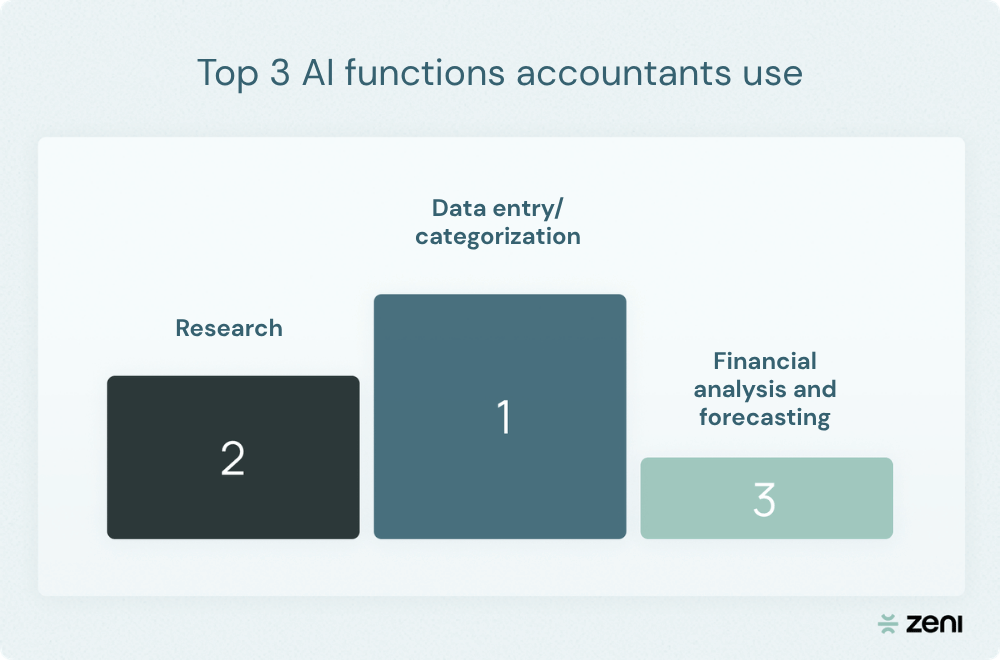
Accounting AI use cases are also becoming more diverse and sophisticated. For example, beyond admin tasks like financial data entry (51%) and research (46%), 44% of accountants use it for financial analysis or forecasting, and 36% for tax preparation.
Many accounting professionals expect this trend to continue. Half of our survey respondents (50%) believe their use of AI will increase significantly over the next three years, while another 34% expect it to increase somewhat.
If you’re looking to implement cloud-based accounting software with built-in AI tools, schedule a free demo of our automated bookkeeping software, which includes an AI accounting agent and an AI CFO agent.
Public discourse around AI in white-collar industries like accounting often focuses on the potential for job displacement. However, our survey suggests that accounting professionals generally see AI as an opportunity.
Nearly half of respondents (47%) said they feel excited about AI's role in accounting, while another 31% described themselves as optimistic. In contrast, only 9% said they were concerned, and just 1% reported feeling threatened by the technology.
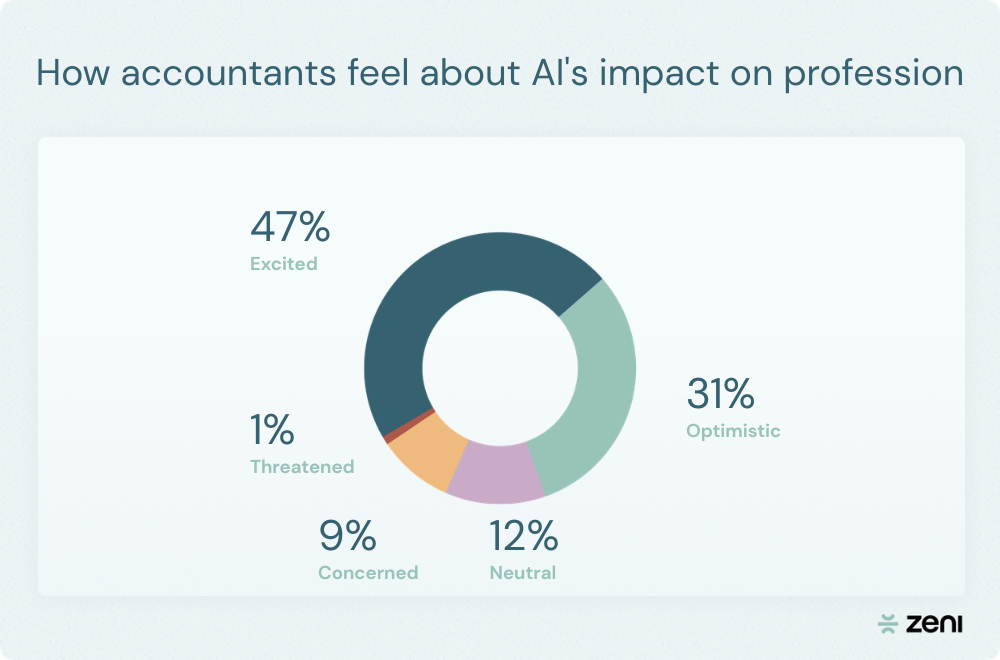
One reason for this positive outlook may be how accountants expect AI to affect their work. Nearly two-thirds (64%) believe AI will reduce routine accounting tasks, while 51% expect it to require them to develop new skills.
Many also expect AI to increase capacity and efficiency. When asked where time saved through accounting automation would go, 59% said they’d use it to take on more clients, 42% said it would reduce burnout, and 25% said it would let them hire fewer people.
For several years now, accounting firms have widely discussed shifting focus away from compliance-focused work toward higher-value advisory services. Our survey results suggest that AI may be accelerating that transition.
When asked how AI would change their role over the next few years, 41% of respondents said they expect it to push them toward more advisory and strategic work.
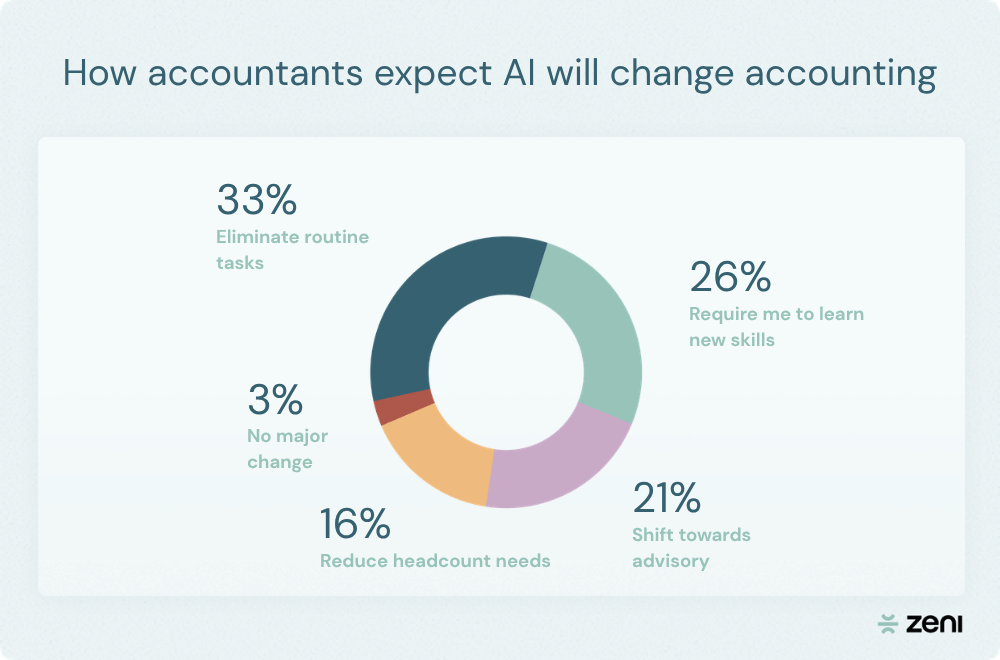
This trend is especially prevalent among public accounting firm teams. We found that 52% expect AI to move their role toward advisory services, while the percentage ranges from 34% to 38% for finance teams and in-house accountants.
This shift is clearly represented in current investment priorities. Expanding advisory services ranked as the third most common in our survey, selected by 19% of respondents. Only AI tools (33%) and talent acquisition (24%) ranked higher.
Not all accounting professionals are embracing AI tools with the same level of enthusiasm. In fact, across just about every measure of our survey, finance leaders emerged as the most aggressive adopters of the technology.
For example, some of the most striking trends included:
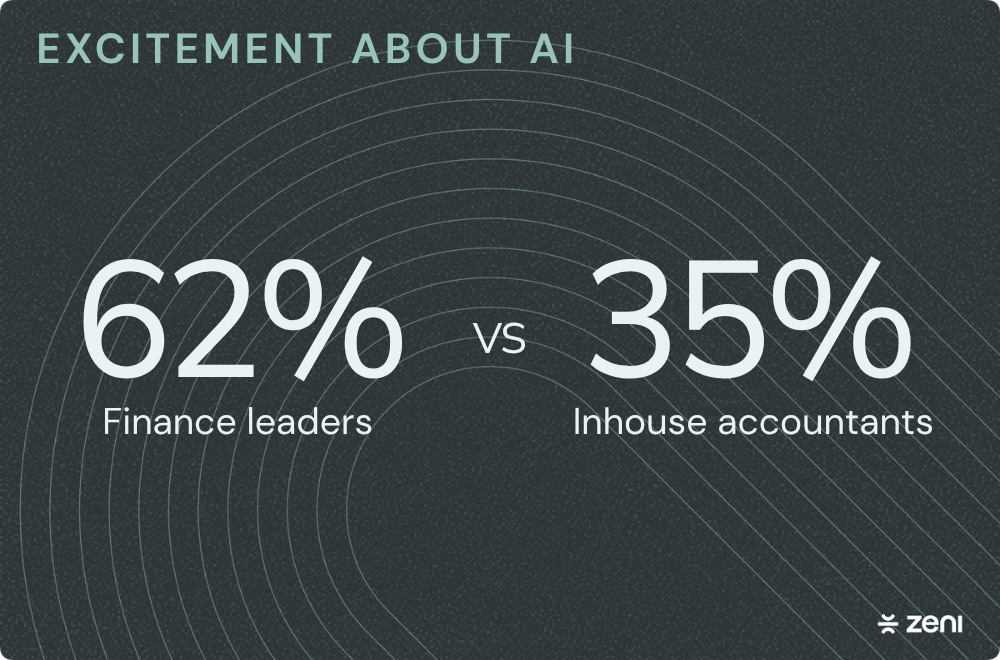
This may be because finance leaders are in charge of their company’s budgets and often see the return on investment (ROI) from AI most clearly. But whatever its cause, this attitude is also causing finance leaders to see the most AI time savings on average.
When you look at which types of accounting professionals are saving at least six hours per week with AI, it includes 68% of finance leaders, 31% of public accountants, and 37% of in-house accounting professionals.
Another potential contributor to this trend is that finance leaders are much more likely to use AI inside accounting software at 76% versus roughly 40% for the other two groups.
In many ways, the accounting profession is split between two main AI adoption tracks: Larger firms are investing heavily in training and implementation, while smaller firms are often taking a more ad hoc approach.
The gap is immediately noticeable in their differing AI education trends: 71% of large firms with 51+ employees reported providing AI training, compared to just 62% of midsize firms with 11 to 50, and 44% of small businesses with 10 or fewer.
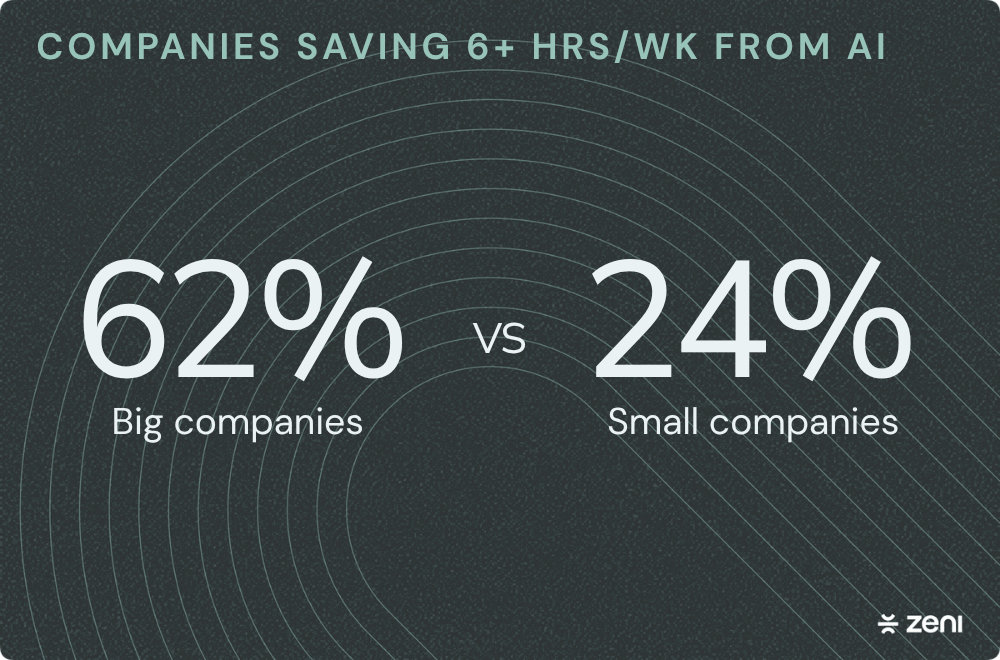
Once again, this increased investment in AI appears to be driving greater time savings. Nearly two-thirds of professionals at large firms (62%) reported saving at least six hours per week through AI, versus 40% at midsize firms and 24% at small firms.
However, the story is more nuanced than it seems at first glance. In reality, smaller accounting businesses may just be prioritizing a lower-cost AI strategy, with 80% using free consumer tools and just 20% redirecting freed capacity into advisory services.
This likely stems from their tendency to have proportionately smaller budgets, as reflected in the fact that more than a quarter (27%) report facing very difficult staffing challenges, compared to just 8% of large firms.