.avif)
.avif)

Ready to invest in AI?
Schedule time with Zeni's finance pros to learn more.
Thank you! Your submission has been received!
Oops! Something went wrong while submitting the form.
Series C funding rounds often provide the capital startups need to scale and pursue a successful exit.
In this guide, we explore our unique research on Series C companies in 2026, including average fundraising amounts, typical headquarters locations, and the most commonly represented industries.
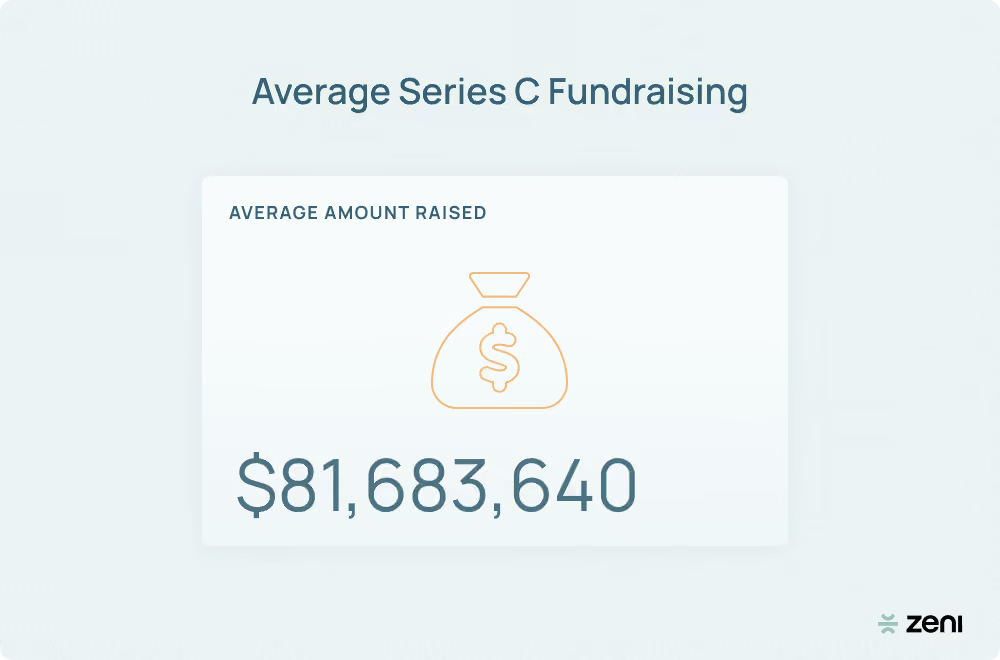
Among Series C companies between May 20, 2025, and May 20, 2026, the average fundraising amount was approximately $81.7 million, up from roughly $69 million during the strict 2025 calendar year.
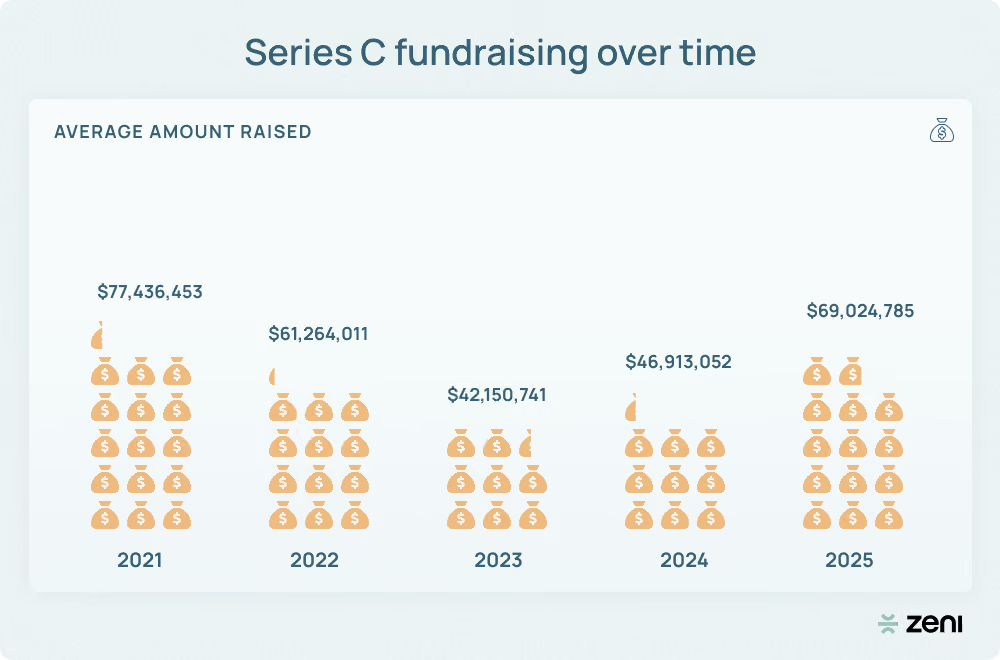
This marks the culmination of the venture capital financing market’s recovery after several down years. The average Series C round fell from $77.4 million in 2021 to just over $42.1 million in 2023 and remained below the $70 million threshold through 2025.
The reversal of that downward trend suggests a renewed confidence among institutional investors in later-stage startups with established business models and clear market traction.
However, it’s worth noting that the median fundraising amount during the period ending in 2026 is much lower at $44.1 million, which is likely a more realistic indication of what you might expect to raise as a Series C company.
The gap between the two metrics suggests that a small number of high rounds skewed the Series C average upward. The most notable examples include several artificial intelligence (AI) deals, which have heavily shaped the 2026 funding landscape so far.
The largest came from DayOne, a Singapore-based AI infrastructure and hyperscale data center company. DayOne raised $2 billion in its Series C funding round in January 2026, bringing its total equity financing to nearly $7.9 billion.
Another outsized raise came from Skild AI, a robotics and artificial intelligence company headquartered in Pittsburgh, Pennsylvania. The company secured $1.4 billion in Series C financing in March 2026, reaching a total funding amount of roughly $1.8 billion.
Average total funding amounts for Series C companies also reached new highs in 2026. Between May 20, 2025, and May 20, 2026, the average total funding raised by Series C companies was approximately $163.8 million.
The trends in this area show a similar pattern to individual Series C round sizes. After reaching a peak in 2021 at roughly $124.9 million, average total funding amounts declined through 2023 to around $86.9 million.
However, total funding levels recovered more quickly than individual round amounts, surpassing previous highs by 2025 before continuing upward into 2026.
Once again, the median total funding amount during the period ending in 2026 was substantially lower than the average at $92.7 million. This is another reflection of a small number of heavily funded companies pushing average measurements higher.
Here too, DayOne led the group with nearly $7.91 billion in total funding raised to date.
After DayOne, the most heavily funded Series C company in 2026 is Sierra Space, a Colorado-based aerospace technology company. Sierra Space raised $550 million in its latest funding round, bringing its total funding to roughly $2.2 billion.
In third place is I Hate Flying Bugs, a South Korean edtech platform focused on AI-powered learning management tools. Despite a relatively modest latest raise of roughly $14.6 million, the company’s total equity funding is nearing $2.1 billion.
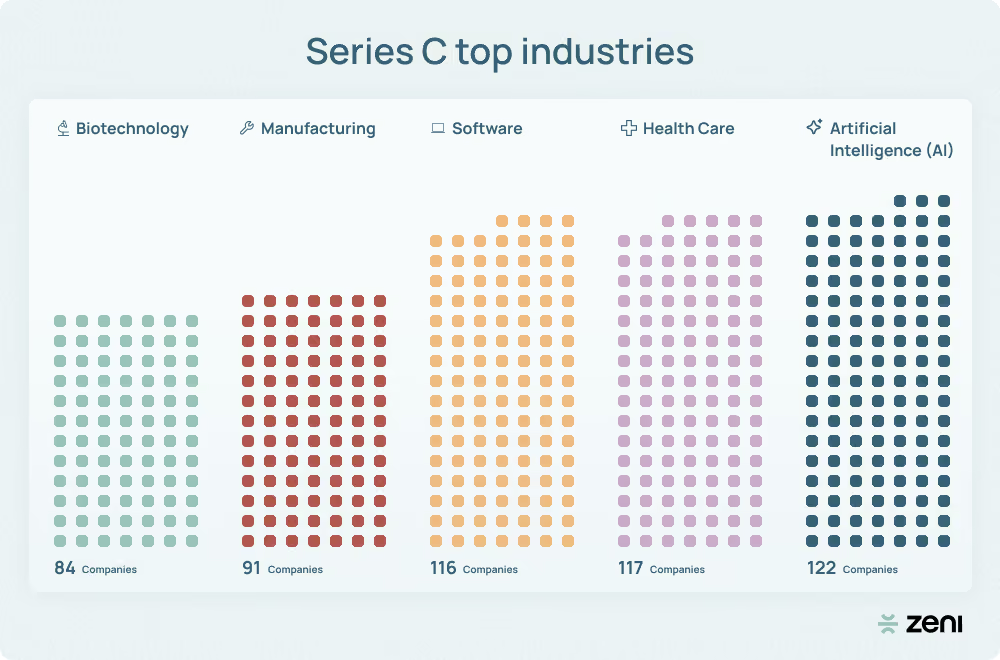
AI, healthcare, and software companies were the most represented in the Series C market over the period ranging from May 20, 2025, to May 20, 2026. Manufacturing and biotechnology companies also accounted for a significant share.
AI industry tags appeared in 20.2% of Series C companies, narrowly ahead of healthcare at 19.4% and software at 19.2%. Meanwhile, manufacturing was associated with 15.1% of Series C companies and biotechnology with 13.9%.
The recent emphasis on AI seems to have strengthened several adjacent categories. For example, this likely contributed to the strong representation of semiconductor, robotics, machine learning, and hardware companies in the Series C space.
Even within the United States, the distribution of Series C is also highly localized. California alone accounts for 122 companies, representing more than half of all Series C startups in the country.

New York follows with 30 companies, while Texas and Massachusetts are tied at 17 each. Together, these four states make up the vast majority of U.S. Series C activity.

Based on a median founding date of January 1, 2018, among Series C companies in our 2026 dataset, it takes approximately 7.5 years to get to the Series C stage.
Many companies need roughly 12 to 24 months to move between early startup funding stages like Pre-Seed funding, Seed funding, and Series A funding, then 18 to 36 months to progress through each later round, like Series B funding and beyond.
In practice, series funding timelines vary significantly depending on factors like sector, revenue growth rate, and fundraising conditions. For example, software companies often move more quickly due to lower capital requirements and faster scaling cycles.
In contrast, sectors like biotech and manufacturing typically take longer due to their extended research and development (R&D) and infrastructure buildout timelines.
Series C is often described as the “scale round.” By this point, revenue traction is already well established, unit economics are generally clear, and growth acceleration becomes the primary motivation for additional funding.
For example, companies may use Series C capital to pursue geographic expansion, grow sales teams, or build out supporting infrastructure. Generally, they’re optimizing what already works rather than testing viability.
In many cases, Series C is also the funding stage where companies begin seriously evaluating potential exit paths, whether through acquisition from a potential investor or an initial public offering (IPO).
As a result, Series D funding and later-stage rounds—such as Series E, Series F, and even Series G—are often seen as “extension rounds.”
Many companies raising capital from investment banks, hedge funds, or a VC firm beyond Series C are attempting to maintain their runway, giving them time for a profitable exit.
![Venture capital trends and statistics in 2026 [new data]](https://cdn.prod.website-files.com/642b3b2440806566d7573934/6a7a31b1282ad91171af9142_venture-capital-trends-and-statistics_%402x.webp)


.avif)
.avif)
.webp)